SECPlot
Processing and visualization of spectroelectrochemical data
Academic software, free of charge, for Windows and Linux. No MATLAB licence required.
D = C ST + E
SECPlot loads a three-dimensional dataset — an intensity measured for every wavelength and every frame — shows it as a surface or a map, and takes it apart into the spectra and the time profiles of the species that make it.
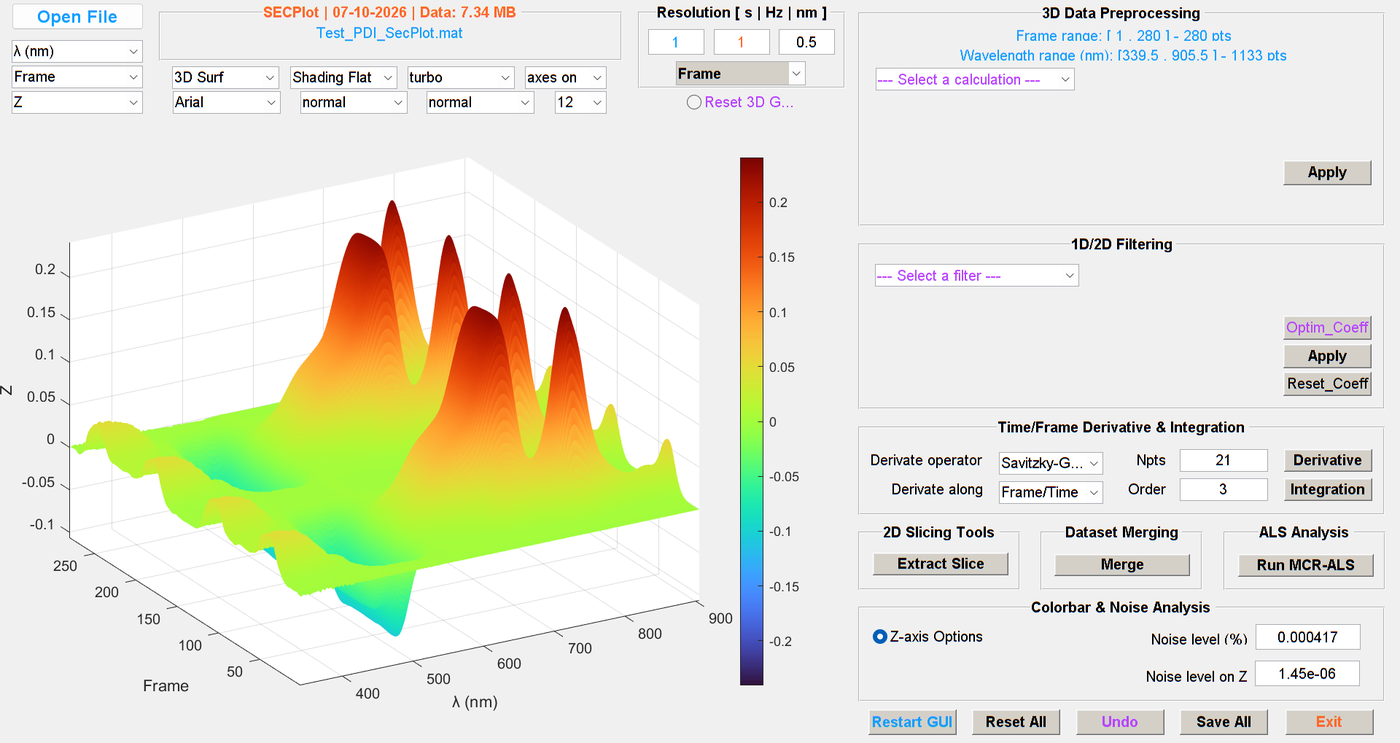
Seeing the whole experiment
A spectroelectrochemical run is thousands of spectra. SECPlot shows them at once, as a 3D surface or a 2D map, with the frame axis switched to time in one click: the switch is purely visual, the data are never modified.
Processing
- algebraic operations and baseline corrections on the whole dataset
- 1D and 2D filters (Savitzky-Golay, Gaussian, mean, median), with the noise level measured
- derivative and integration along time or frames
- slices at a fixed wavelength (kinetics) or at a fixed frame (spectra), with peak detection
- two acquisitions merged into a single dataset, and chopped-beam measurements rebuilt
- results written as text files and to Excel
Multivariate curve resolution (MCR-ALS)
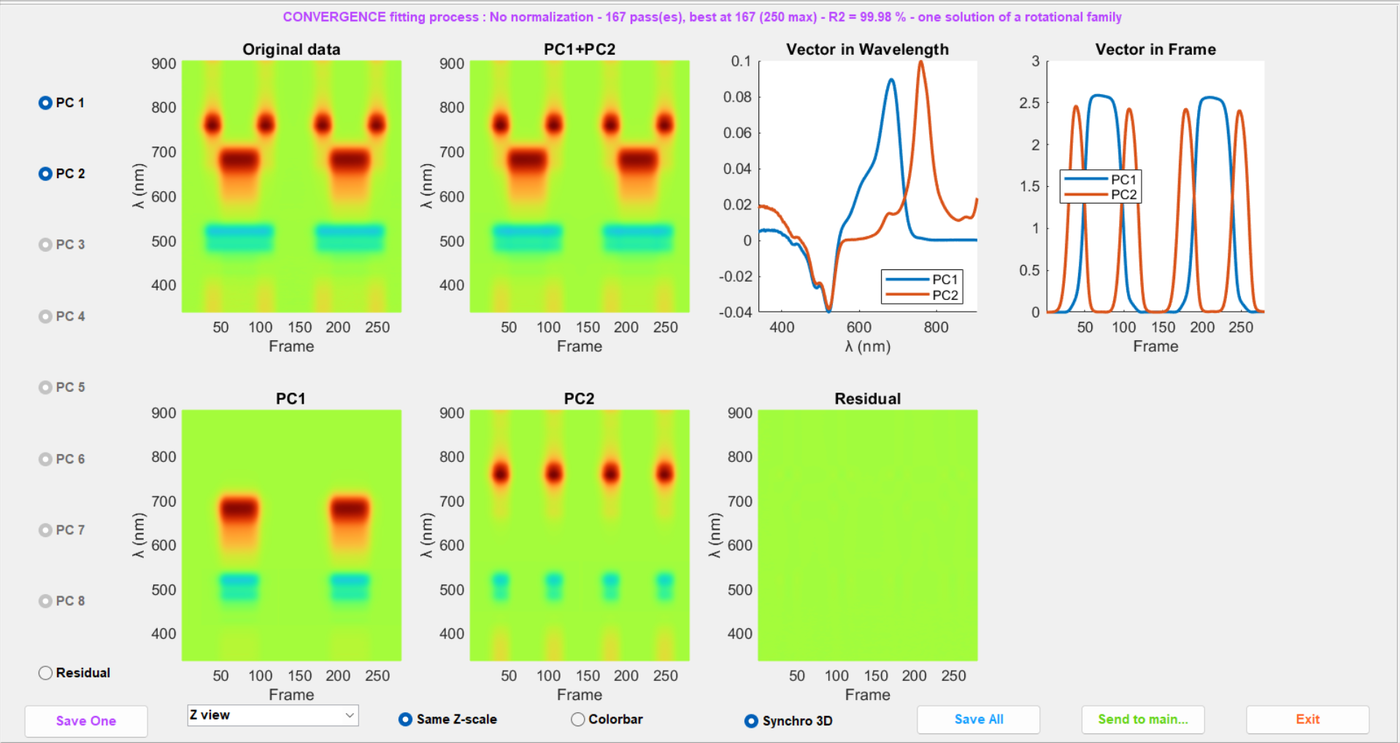
The dataset is written as a product: the concentration profiles C of a few components times their spectra S, plus a residual. SECPlot proposes the number of components from the singular values and says what it rests on; the count stays yours.
- starting profiles chosen automatically (purest variables), picked by hand or measured from presence windows
- constraints on either factor: non-negativity, unimodality, presence windows, blank frames held at zero
- processing along frames or along wavelengths, with the profiles reprojected when the axis is switched
- the outcome named: convergence, divergence, or a solution that only reproduces the singular-value decomposition
Checked
Every version is compared with more than 900 recorded cases covering the file readers, the filters, the matrix operations and the resolution. A change that moves a result is either a correction, said as such, or a fault.
Getting started
A user guide in French and English explains every button and every field, and the order of work in the resolution window. No computing background is required. The interface is in English.
Obtaining SECPlot
SECPlot is free of charge for everyone, students and researchers alike. It is distributed as 64-bit Windows and Linux executables that need only the free MATLAB Runtime: no MATLAB licence is required. Its licence of use, free of charge, allows it to be installed on as many computers as wished and passed on unchanged; it may not be modified. The demo version needs no formality: everything runs and is shown, nothing is saved. The full version is granted, free of charge too, to users registered with an academic address.
SECPlot comes with absolutely NO WARRANTY.
To obtain SECPlot, write to the developers at echem-tools@univ-angers.fr.
Reporting a problem: Help ▸ Report a problem... in SECPlot prepares a message to the authors — version, system, last error message — that you read, complete and send yourself; the program sends nothing by itself.
Acknowledging SECPlot
If SECPlot contributes to a publication, a thesis or a funded project (ANR, ERC, a European programme…), the authors would be grateful for a mention, for instance in the acknowledgements:
The data were processed with SECPlot (O. Alévêque and E. Levillain, MOLTECH Anjou, UMR 6200 CNRS, University of Angers), software free of charge, available on request from echem-tools@univ-angers.fr.
What the programs send, and what they never send: Data, on the home page.